
You’re holding a film camera, and the light meter is dead — or the camera never had one in the first place. You still want the shot. The Sunny 16 rule is how you get it: a simple way to set a usable exposure from the light outside and the film in your camera.
Sunny 16 exposure examples
In bright sun, set the aperture to f/16 and use a shutter speed close to the reciprocal of the film ISO. If your camera does not offer the exact reciprocal, use the nearest standard shutter speed.
| Film ISO | Exact reciprocal | Nearest standard shutter speed | Bright-sun starting exposure |
|---|---|---|---|
| ISO 100 | 1/100 s | 1/125 s | f/16 at 1/125 s |
| ISO 200 | 1/200 s | 1/250 s | f/16 at 1/250 s |
| ISO 400 | 1/400 s | 1/500 s | f/16 at 1/500 s |
These are starting exposures for a subject in direct sunlight. When the light changes, use the lighting-condition guidance later in this article.
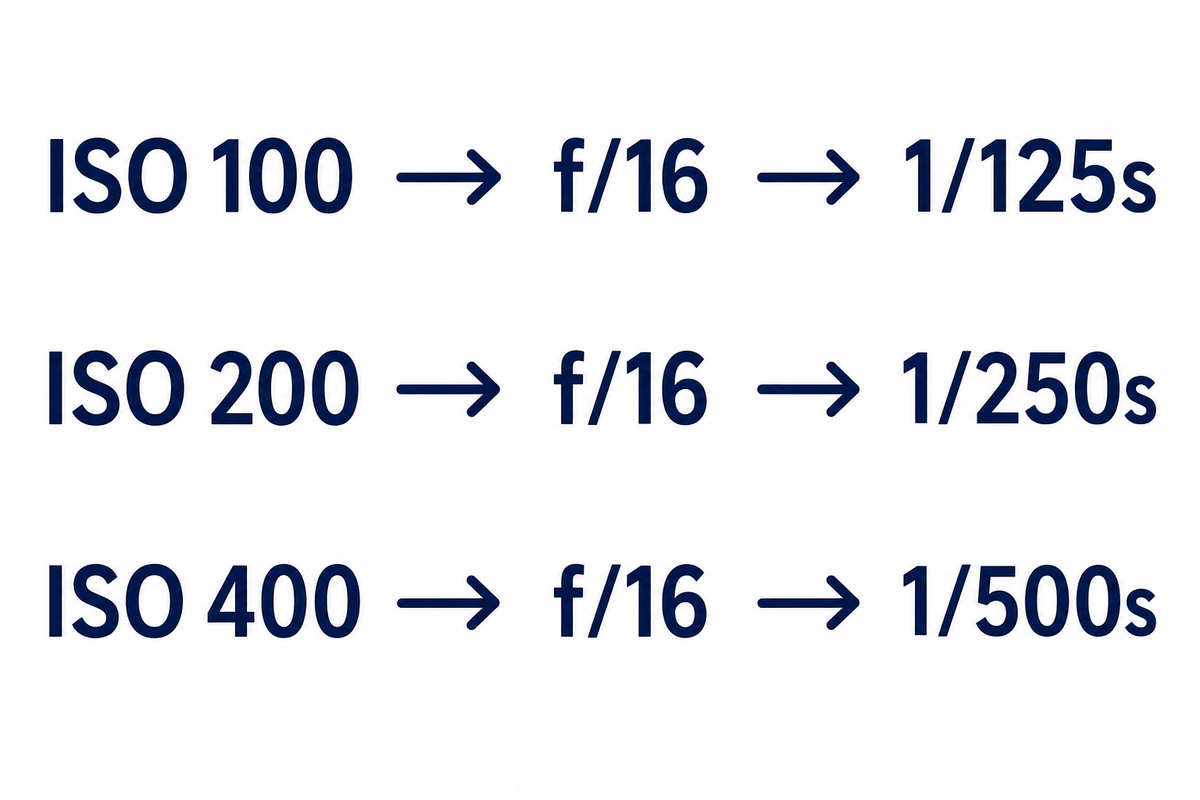
Caption: The Sunny 16 relationship — choose an ISO, set f/16, and use the nearest standard shutter speed to 1/ISO.
What is the Sunny 16 rule?
The Sunny 16 rule is a method of estimating a correct daylight exposure without a light meter. The name comes from the aperture it suggests — f/16 — and it applies to a subject in direct sunlight.
It’s a starting point, not a precision reading. Use it when you have no meter, when the meter is unreliable, or as a sanity check against what the meter says.
The formula
On a sunny day, set the aperture to f/16 and the shutter speed to the reciprocal of the film’s ISO (or the camera’s ISO setting), for a subject in direct sunlight. In shorthand: bright sun = f/16 at 1/ISO.
Kodak documents the same relationship. Its TRI-X 400 datasheet lists f/16 at 1/500 second for ISO 400 film in bright, hazy sun with distinct shadows — and 1/500 second is the reciprocal of 400 rounded to the nearest standard shutter speed.
Your camera may not have the exact speed
That’s fine — use the nearest standard speed. For ISO 100, 1/125 second is the closest available setting to 1/100 second. The standard stops (1/125, 1/250, 1/500) stand in for the exact reciprocals (1/100, 1/200, 1/400), and this matches Kodak’s own guidance, which uses 1/500 for ISO 400 film.
What to do when the light changes
Bright sun is only the baseline. Kodak’s daylight exposure guide for ISO 400 film holds the shutter at 1/500 second and changes the aperture with the light:
| Aperture | Lighting conditions (Kodak) |
|---|---|
| f/22 | Bright/hazy sun on light sand or snow |
| f/16 | Bright or hazy sun, distinct shadows |
| f/11 | Weak hazy sun (soft shadows) |
| f/8 | Cloudy bright (no shadows) |
| f/5.6 | Heavy overcast or open shade |
For a backlit close-up subject in bright sun, Kodak suggests f/8 — two stops more exposure than the f/16 baseline.
This is a manufacturer’s guide for average front-lit subjects — a practical starting point, not an exact reading. It’s written for ISO 400 at 1/500 second; for other film speeds, keep the shutter at the reciprocal of the ISO and use the same apertures.
How aperture and shutter speed trade off
Open the aperture one stop and you can cut the shutter time in half for the same exposure; close it one stop and you double the time. (One stop is a factor of about √2 in f-number.)
A worked example: 1/250 second at f/11 gives the same exposure as 1/125 second at f/16. Open one stop (f/16 → f/11) and halve the time (1/125 → 1/250) — same exposure.
That’s what makes the rule flexible. Move off f/16 when you want a faster shutter (to freeze motion) or a wider aperture (for shallower focus), and shift the other setting the opposite way.
When to trust Sunny 16
- You have no meter, or it isn’t working or isn’t trustworthy.
- The subject is in direct, consistent sunlight.
- The subject is very bright or very dark. Sunny 16 is based on incident light (the light falling on the scene) rather than reflected light (what most camera meters read), so it compensates for subjects that would fool a meter.
When to use a light meter instead
- You need precision, not an estimate.
- The light doesn’t match your assumption — cloud, shade, or backlighting all move you off the f/16 baseline, and the guide is only approximate.
- Bright, reflective scenes such as snow or sand need a smaller aperture (f/22 rather than f/16 in Kodak’s guide), so the sunny baseline doesn’t apply as-is.
- The light is changing or mixed, and judgment matters more than a fixed number.
Mistakes that waste a roll of film
- Using the f/16 setting in the wrong light — overcast, shade, and backlit scenes need a wider aperture or slower shutter.
- Treating the exact reciprocal as required — 1/125 for ISO 100 is correct, not an error.
- Treating Sunny 16 as an exact reading — it’s an estimate, so small differences are normal.
- Getting the backlight compensation backwards — add light (open up / slow down), don’t subtract it.
Sunny 16 vs a light meter
- A light meter measures and gives a specific reading; Sunny 16 gives a starting estimate from a rule of thumb.
- Most camera meters read reflected light and can be fooled by very bright or very dark subjects; Sunny 16 is based on incident light, so it compensates for those subjects.
- Use Sunny 16 when there’s no meter or as a cross-check. Reach for a meter when the light is tricky, changing, or you need precise, repeatable exposure.
Once you’ve made the exposure, the film still needs to be developed — see our guide on how to develop film at home.
Quick answers
- What is the Sunny 16 rule? A method of estimating daylight exposure without a meter: f/16 at a shutter speed near 1/ISO in direct sun.
- What shutter speed for ISO 400? f/16 at 1/400 s, or 1/500 s if your camera doesn’t offer 1/400.
- What shutter speed for ISO 100? f/16 at 1/100 s, or 1/125 s (the nearest standard speed).
- Does Sunny 16 replace a light meter? No — it’s an estimating method, not a precision reading.
- What about cloudy days? Open up from f/16 — Kodak’s guide suggests f/11 for weak hazy sun and f/8 for cloudy bright.
- Why f/16? It’s the aperture that, paired with a 1/ISO shutter speed, gives a standard bright-sun exposure.
Sources
- Kodak, “KODAK PROFESSIONAL TRI-X 320 and 400 Films” datasheet (F4017), “Exposure — Daylight” section — http://kodakprofessional.com/sites/default/files/wysiwyg/pro/resources/f4017_TriX.pdf (primary manufacturer source).
- Wikipedia, “Sunny 16 rule” — https://en.wikipedia.org/wiki/Sunny_16_rule (secondary/reference; retrieved 2026-09-21; last edited 10 June 2026).